.svg)


Get in Touch
Recent posts



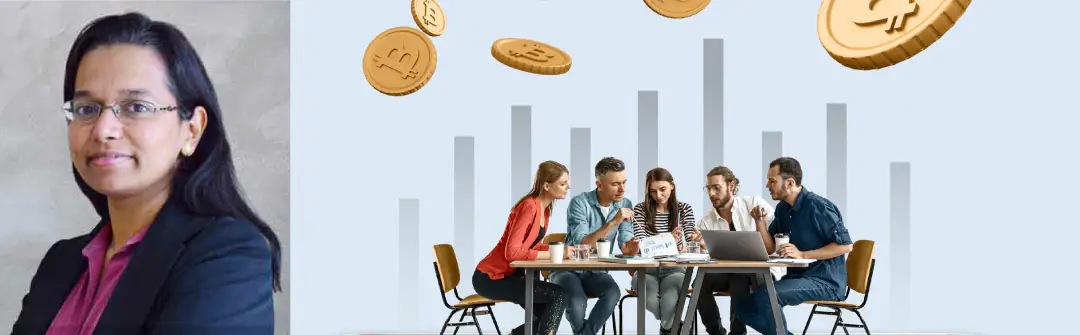
 Susan Thomas, Director, Kreston Menon Corporate Services
Virtual Assets, commonly referred to as crypto assets, draw a lot of attention of both companies and private individuals. Dealing with virtual assets calls for an understanding of the regulatory environment to allow investors and operators alike to assess opportunities. In light of the opportunities and with a more proactive approach, the Government of Dubai established the world’s first independent regulator for virtual assets – the Virtual Assets Regulatory Authority (VARA) in March 2022.
Dubai’s Virtual Assets Regulatory Authority (VARA) was founded under the aegis of the UAE’s Virtual Assets Law. VARA is an independent regulator for regulation, governance and licensing of cryptocurrencies, Non Fungible Tokens (NFT’s) and other virtual assets in Dubai. This was established with authority over the virtual asset market across the Emirate of Dubai, including the Free Zones except the Dubai International Financial Centre (DIFC) and Abu Dhabi Global Market (ADGM). VARA seeks to collaborate with global Virtual Asset Service Providers (VASPs) and international regulatory authorities.

VARA – The Virtual Assets Law:
The UAE with the enactment of the Virtual Assets Law and establishment of VARA has been trying to create an environment for the growth of crypto industry whilst being keen to reduce the potential financial crime risk in this nascent industry.
Law No 4 of 2022 Regulating Virtual Assets in the Emirate of Dubai defines the following terms used by the Regulator, to describe virtual assets quite broadly which allows for adaptability and flexibility as virtual assets:
• ‘Virtual Asset’ – defined as digital representation of value that may be digitally traded, transferred, or used as an exchange or payment tool, or for investment purposes. This includes Virtual Tokens and any digital representation of any other value as determined by VARA.
• ‘Virtual Token’ – defined as a digital representation of a set of rights that can be digitally offered and traded through a Virtual Asset Platform.
These definitions broaden the common understanding of regulated crypto activities such as trading of crypto currencies and allowing VARA to create specific rules for increasing the range of virtual assets as they are created such as NFT’s and utility tokens.
License Application process in the mainland:
Under the Regulations, any firm seeking to engage in virtual asset activities in Dubai must obtain a Virtual Asset Service Provider (VASP) license. The application process for obtaining such license consists of two stages namely:
1. Obtaining an initial approval by submitting a preliminary disclosure questionnaire provided by VARA, supporting documentation such as a business plan, details of the beneficial owners and senior management to obtain initial approvals.
2. Once initial approval is obtained and after finalizing the incorporation and operational setup of the entity, the final approval is obtained and VASP license is issued to the firm to engage in the licensed virtual assets activities.
VASP license is issued for one year and must be renewed annually. It is to be noted that the VASP licensing process is separate from and supplemental to the incorporation of the entity before the Dubai Department of Economy and Tourism (for mainland entities) or the relevant Free Zone Authority for entities incorporated in the Free Zones in Dubai other than the DIFC.
DIFC – Digital Assets Law:
Independent of the Dubai wide regulatory regime, described above, the DIFC recently introduced the Digital Assets Law No 2 of 2024 (“Digital Assets Law”) on March 8, 2024. This law sets out the characteristics of digital assets and establishes how they may be controlled, transferred and dealt with by the interested parties.
The Digital Assets Law clearly defines ‘Digital Asset’ as an asset that:
• Exists as a virtual unit and manifested by the operation of software and network generated data;
• Exists independently of any particular person and legal system;
• Is not able to be copied;
• Once used or consumed by a person or specific group of persons, is not able to be used or consumed by another person.
• Is an intangible property
In addition to defining the attributes of digital assets, as highlighted above, The Digital Asset Law sets out the conditions required for a person to have control of a digital asset and how the title can pass.
Within the DIFC, firms who require to provide financial services in relation to digital assets will need to obtain the appropriate license from Dubai Financial Services Authority (DFSA).
License Application process in the DIFC:
The Free Zones follow an activity based licensing framework and therefore virtual asset activities are treated in the same manner as the other financial service businesses and have more tailored rules with specific regulations for virtual assets.
1. A letter of intent is required to be submitted and an initial informal review with DFSA to be scheduled. Application shall be submitted along with a regulatory business plan. Initial approval to be obtained from DFSA.
2. Registration with DIFC Registrar of Companies is to be initiated after receiving the initial approval from DFSA. A local bank account to be opened, provide proof of remittance of capital and secure office space from where it will conduct its activities. Upon successful compliance of all requirements, license shall be issued.
A snapshot of the UAE Virtual Asset Regulation:
Federal Level Regulation
o Securities and Commodities Authority o UAE Central Bank
Financial Free Zones
o Abu Dhabi Global Market (ADGM)
o Dubai International Financial Centre (DIFC)
Dubai Regulator
o Virtual Asset Regulatory Authority (VARA)
Federal Level Regulation
o Securities and Commodities Authority
UAE CENTRAL BANK
The UAE Central Bank is the sole regulator for the ‘central bank digital currencies’.
Virtual Asset service providers are treated like designated non – financial businesses and professionals must comply to the required AML compliances.
Registration with Financial Intelligence unit is required along with the submissions of ‘suspicious transactions reports’ which is required from time to time.
Looking Ahead:
The future of virtual currency in the UAE requires considerably less speculation than in other jurisdictions owing to the robust VA framework present. The UAE Central Bank launched its strategy for ‘The Digital Dirham’ on 23 March 2023. Phase One comprises three major pillars- the soft launch of mBridge to facilitate real value cross -border transactions for international trade settlement, proof of concept work for bilateral bridges with India, one of the UAE’s top trading partners and soft launch for domestic Central Bank digital currency issuance covering wholesale and retail usage.
 Vineet Rathi, Managing Partner, Kreston OPR Advisors LLP
- Faster and more accurate data collection: RPA can automate data collection from various sources, consolidating it into a single system for analysis. This process is up to 10 times faster than manual methods.
- Improved efficiency: By automating repetitive tasks, RPA frees up auditors to focus on higher-value activities, such as data analysis and risk assessment.
- Increased quality: RPA provides a consistent and repeatable process, ensuring that no steps are missed and data is collected accurately.
- Enhanced analytics and insights: RPA can help identify trends, outliers, and risks that might be overlooked in manual audits.
- Elimination of manual data entry: RPA bots can automate tasks such as copying and pasting data between systems,
- Significantly reducing time and effort while minimizing human error.
- Improved data accuracy: RPA can validate data against predefined rules, automatically flagging discrepancies and improving overall data quality.
- Enhanced employee satisfaction: By automating mundane tasks, employees can focus on more fulfilling, high-value work, potentially leading to higher job satisfaction and reduced turnover.
- Cost reduction: The implementation of RPA can lead to significant cost savings by reducing the need for manual labor in routine tasks.
- Process optimization: RPA can help identify inefficiencies in business processes and suggest improvements.
- Risk management: By analyzing large volumes of data, RPA can help identify potential risks and compliance issues more effectively.
- Strategic decision-making: RPA can provide real-time insights and analytics to support informed decision- making.
 Kreston Menon

Global Business Trends: Do UAE Business Leaders Believe More Business will Expand Overseas in the Next 12 Months?
Overseas business expansion is widely expected to Increase
| Significantly increase | 54% |
| Moderately increase | 39% |
| No change | 6% |
| Moderately decrease | 1% |
| Significantly decrease | 0% |
| Not sure | 0% |
At 93%, the UAE is one of the most optimistic countries in the world that global expansion is on the rise.
“The UAE Interpreneur report is precise and will be valuable for any investor. In the UAE, all foreign Governments are actively partnering with the UAE government to attract and bring in foreign direct investments as Government support is key in expanding operations. Every Diplomatic Mission in UAE has set up their separate Trade Offices to attract UAE interpreneurs. And the investor numbers increasing regularly. New areas and sectors for investments are discussed and planned. The main challenges for UAE Interpreneurs for international expansion are market volatility, right business partner and talent. Most of the Governments have formed special Teams to handle international investors and that Team relates with the Trade Offices in UAE. This helps the Interpreneurs expansion plans go seamless. A trusted and knowledgeable advisor is what all interpreneurs look for to take them through the process.”
Sudhir Kumar
Senior Partner & Head-Corporate Communications
Kreston Menon
Which Markets Do UAE Businesses Prefer to Expand into?
Which, if any, of the following regions or countries would you / your business considering expanding to? (Select all that apply)
| Western Europe (e.g. Germany, France, UK, etc) | 62% |
| Middle East | 54% |
| North America (e.g. USA, Canada, Mexico, etc) | 44% |
| North Asia (e.g. China, Japan, Korea, etc) | 34% |
| Eastern Europe (e.g. Poland, Hungary, Romania, etc) | 28% |
| South Asia (e.g. Thailand, Vietnam, Singapore, etc) | 24% |
| Africa | 24% |
| South America (e.g. Brazil, Chile, Colombia, etc) | 19% |
| Australia/New Zealand | 13% |
| Other | 2% |
What Makes a Country More Attractive to UAE Businesses Looking to Expand Globally?
Which, if any, of the following would make a country most attractive for international expansion? [Select up to five]
| Government support (e.g. grants, incubators, and mentorship programs) | 49% |
| Skills and talent (e.g. availability of local talent and openness to skilled talent immigration) | 45% |
| Favorable trade agreements (e.g. free trade zones, diplomatic partnerships, or preferential tariff treatment) | 42% |
| Tech infrastructure and digitalisation | 42% |
| Future economic growth prospects | 39% |
| Alignment with long-term growth strategy (e.g. regional investment into specific industries) | 39% |
| Favorable tax policies | 33% |
| Transparent regulatory environment | 31% |
| Geographic proximity to existing operations | 24% |
| Cultural and language similarity to existing operations | 23% |
What Motivates UAE Interpreneurs to Expand Internationally?
Half of UAE businesses are driven to expand internationally by market growth opportunities. Meanwhile, 43% aim to outpace rivals by securing new market footholds, and 38% are motivated by access to cutting-edge digital technologies and innovation.
What are the biggest international expansion challenges in 2024 according to UAE interpreneurs?
Top 3 biggest challenges during international expansion process
| Managing economic volatility (e.g. currency fluctuations, inflation and or low growth) | 46% |
| Adapting logistics and supply chain issues (e.g. managing international shipping, distribution, and communication) | 43% |
| Finding the right local partners (e.g. building reliable and trustworthy relationships) | 39% |
Risk: What do UAE CEOs Think are the Biggest Risks to Global Business Expansion in 2024?
How much of a risk do the following pose to your business’s international expansion or planned international expansion?
| Escalating geopolitical tensions and instability | Disruptive risk | 6% |
| Significant risk | 36% | |
| Moderate risk | 29% | |
| Minimal risk | 17% | |
| No risk | 10% | |
| Not Sure / Not applicable | 2% | |
| Economic slowdown or recession | Disruptive risk | 17% |
| Significant risk | 25% | |
| Moderate risk | 26% | |
| Minimal risk | 21% | |
| No risk | 10% | |
| Not Sure / Not applicable | 1% | |
| Financial market and foreign exchange volatility | Disruptive risk | 11% |
| Significant risk | 33% | |
| Moderate risk | 26% | |
| Minimal risk | 19% | |
| No risk | 11% | |
| Not Sure / Not applicable | 0% | |
| Cybersecurity threats and data breaches | Disruptive risk | 8% |
| Significant risk | 27% | |
| Moderate risk | 33% | |
| Minimal risk | 17% | |
| No risk | 12% | |
| Not Sure / Not applicable | 3% | |
| Talent shortages and skilled labour gaps | Disruptive risk | 7% |
| Significant risk | 25% | |
| Moderate risk | 30% | |
| Minimal risk | 22% | |
| No risk | 16% | |
| Not Sure / Not applicable | 0% | |
| Technological disruption from AI and new technologies | Disruptive risk | 6% |
| Significant risk | 23% | |
| Moderate risk | 25% | |
| Minimal risk | 24% | |
| No risk | 22% | |
| Not Sure / Not applicable | 0% | |
| Environmental disruption and extreme weather | Disruptive risk | 8% |
| Significant risk | 27% | |
| Moderate risk | 32% | |
| Minimal risk | 19% | |
| No risk | 13% | |
| Not Sure / Not applicable | 1% |
Private Equity vs Venture Capital: Which is the Preferred International Expansion Funding Source for UAE Businesses?
| Private investors (including HNWIs) | 52% |
| Venture capital or private equity | 47% |
| Capital markets (i.e. IPO) | 39% |
| Employee equity schemes | 39% |
| Government funding | 36% |
| Management buyout | 36% |
| Crowdfunding | 34% |
| Debt | 55% |
| None of the above | 0% |
Understanding Global Tax: Is the C-Suite Ready for a Global Tax Threshold?
How confident are you in your understanding of the global international tax rules (for example transfer pricing, VAT) that govern multinational businesses?
| Extremely confident: I have a deep understanding of global tax rules and their implications for multinational businesses | 43% |
| Confident: I have a good grasp of key principles and can navigate common scenarios, but may seek external guidance for complex situations | 49% |
| Not very confident: My understanding of global tax rules is limited, and I rely heavily on external advisors for guidance and analysis | 8% |
The Growing Importance of ESG for UAE Investors and Interpreneurs
| We do / would prioritise ESG | 42% |
| We do / would value ESG, but it wouldn’t be our top priority | 35% |
| We do / would consider ESG practices but if only if they don’t interfere with our other priorities | 20% |
| We don’t / wouldn’t strongly consider ESG practices | 2% |
| We don’t / wouldn’t consider ESG practices at all | 1% |
| Not sure | 0% |
The Benefits of AI in International Business Operations
To what extent do you agree or disagree with the following statement: ‘I feel prepared to harness the benefits of AI in global business operations within the next two years?
| Strongly agree | 60% |
| Somewhat agree | 34% |
| Neither agree nor disagree | 5% |
| Somewhat disagree | 1% |
 Pushpakaran Parambath, Senior Partner - Kreston Menon Corporate Services
- Develop the UAE’s industrial sector, both macro and micro level.
- Increase its in-country value (ICV) program.
- Establish the country as a preferred global hub for industries.
- Build the reputation of the UAE’s industrial products through the promotion of exports to global markets.
- Create quality job opportunities in the industrial sector.
- Established an integrated R&D ecosystem
- Continuous efforts to position UAE as a pioneering global destination for technology and innovation
- Improvement in developing an advanced technology roadmap that drives innovation
- Established standards and metrology that support advanced technology adoption
- Catalysing the adoption of the 4IR technology to boost the productivity of anchor industries
- Consistent monitoring of ICV program
- Continuous promoting ‘Made in the Emirates’ brand and national products
- Developed an integrated quality infrastructure
- Continuous negotiation of reciprocal trade agreements and work to control the classification system of traded products for export and import
- New industrial law has been implemented
- Offering attractive energy and gas tariffs to eligible sectors
- Launched a framework for partnerships with industrial sectors to develop standards and metrology
- Providing flexible financing at competitive costs for priority sectors
- Digital transformation to simplify registration, licensing and fee procedures
- Built a data management platform
- Food, beverage, and agricultural technology
- Pharmaceuticals
- Electrical equipment and electronics
- Petrochemicals and chemical products • rubber and plastics
- Machinery and equipment
- Hydrogen
- Medical technology
- Space technology
 Ravishanker V, Director - Taxation, Kreston Menon
The Organisation for Economic Cooperation and Development (OECD) has explained Base Erosion and Profit Shifting (BEPS) as ‘tax planning strategies used by multinational enterprises that exploit gaps and mismatches in tax rules to avoid paying tax’.




